
Kahoot Review
Proverbs 1:5
Let the wise listen and add to their learning.

Welcome to Photography Review Week!
You've learned how to control light, arrange your subjects, and take more interesting photographs. Now it's time to put your knowledge to the test!
Today, we'll play Kahoot, examine photographs, and discover how small changes can make a big difference.
Remember, photography is a skill that improves with practice. Even professional photographers continue learning!
Part 1: Camera Basics Review


The exposure triangle consists of three camera settings that work together to control exposure, or how bright or dark your photograph appears.
1. Aperture (f-stop)
Aperture controls the size of the opening in your lens.
-
A low f-number, such as f/1.8, means a wider opening, more light, and a shallower depth of field.
-
A high f-number, such as f/16, means a smaller opening, less light, and a greater depth of field.
2. Shutter Speed
Shutter speed controls how long your camera's shutter stays open.
-
Fast shutter speed, such as 1/1000, freezes movement.
-
Slow shutter speed, such as 1/15, can create motion blur.
3. ISO
ISO controls how sensitive the camera's image capture is to light.
-
Low ISO, such as 100, generally produces cleaner images.
-
High ISO, such as 3200, helps brighten an image in low light but can introduce more noise.
Think about it: If you're photographing a student jumping in the air, which shutter speed would help freeze the action: 1/30 or 1/1000?
Part 2: Composition Review
Composition is how you arrange the elements inside your photograph. It helps you guide your viewer's eyes toward the subject.

Rule of Thirds
Imagine dividing your photograph into nine equal sections using two horizontal and two vertical lines.
Place your subject along one of the lines or near an intersection to create an interesting composition.

Leading Lines
Use roads, hallways, fences, or other lines to guide your viewer's eyes toward the subject.
Look for lines that naturally lead somewhere interesting.

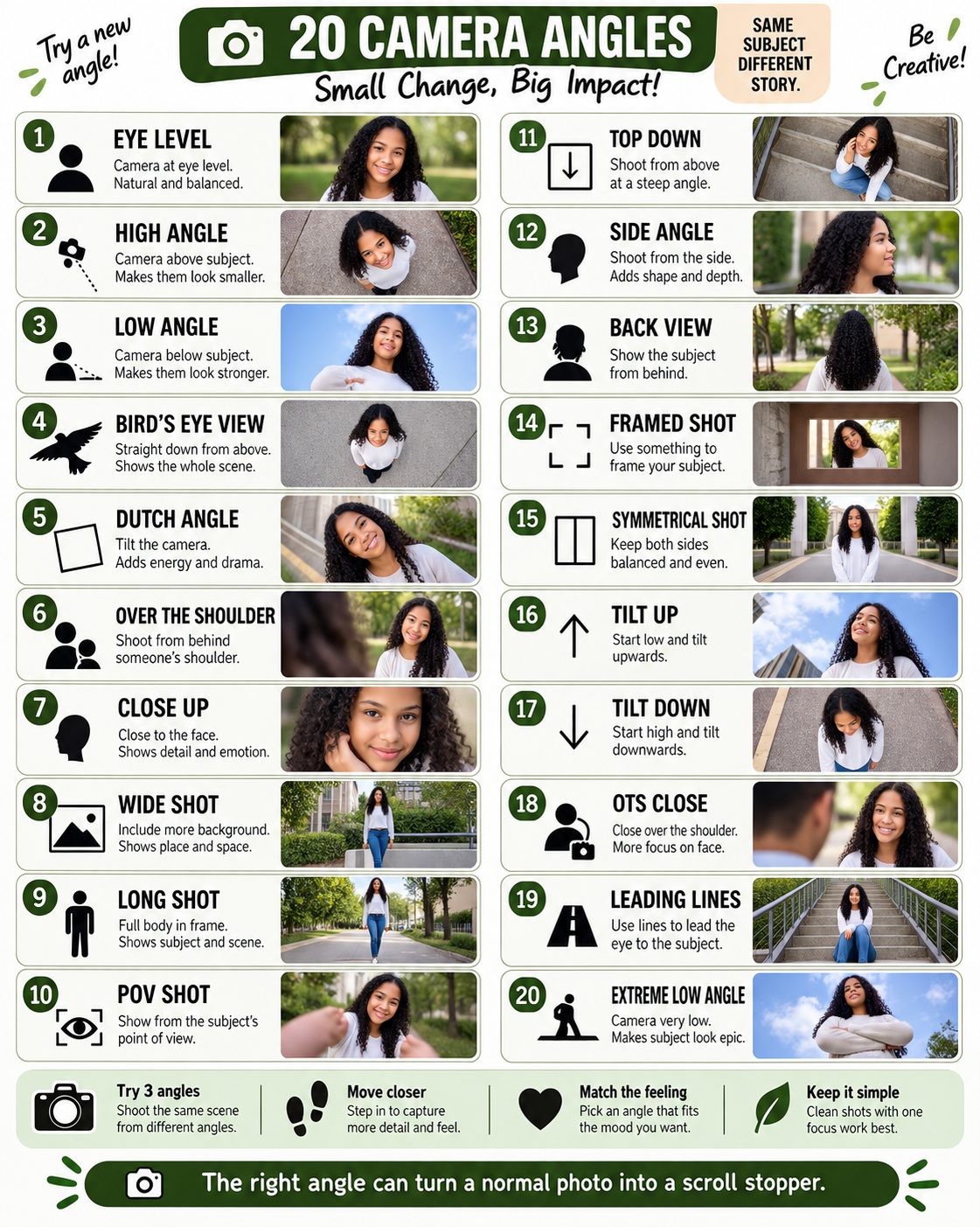
Camera Angles
Changing your camera's position changes how your subject appears.
-
Eye level: Natural perspective.
-
High angle: Looking down.
-
Low angle: Looking up.
Homework
Before & After Photo Challenge
Your mission is to take one photograph you've already submitted and make it better using what you've learned in class.

BEFORE

AFTER
Your assignment:
-
Choose one photograph from a previous photography assignment.
-
Examine it and identify something you could improve.
-
Retake the photograph using at least two techniques you've learned.
-
Compare your original photograph with your improved version.
-
Submit both photographs to Google Classroom, labeled BEFORE and AFTER.
Include a short explanation answering these three questions:
-
What did you change?
-
Which two photography techniques did you use?
-
Why do you think your new photograph is better?
Homework submission checklist
Final Thought
Proverbs 1:5 reminds us that wise people continue learning.
You don't have to take a perfect photograph today. What matters is that you listen, practice, accept helpful feedback, and apply what you've learned.
Every photograph is another opportunity to grow as a photographer!